Thursday, December 02, 2010

Mobile Number Portability (MNP) in India

Mobile Number Portabiblity (MNP) is going to be introduced in India in December 2010 after prolonged delays. MNP is a service by which the customer will be able to retain his number (MSISDN) even after changing his
subscription from one operator/service provider to other. The Telecom Regulatory Authority of India (TRAI)released the MNP regulations on 23 September 2009, though it initiated the MNP introduction procedures as early as July 2005 with the release of consultation papers.

History of MNP
One of the earliest implemetations of number portability was for landline phones in Hong Kong in 1996, introduced as a tool for reversal of franchised monopoly, which was a government policy. In the USA number portability was introduced in 1998 to increase competition in a highly monopolised landline phone market. The idea porting of landline numbers, known as Local number portability was 'ported' to mobile phone networks under the nomenclature MNP. In 1999, Hong Kong (again!) became one of the earliest countries to introduce MNP.

Procedures for porting your number
The procedures mentioned is this section is as per TRAI guidelines as of December 2010, and is subject to change as and when TRAI wishes.
TRAI has specified the procedures for porting a number from one operator to other. It starts when you fall for a really cool tariff plan (like DoCoMo's 1 Ps/sec plan) or a sweeping ad campaign (like Vodafone Zoozoos). Or may be your new house or office area is not covered well by your present operator. You now want to change your operator but you want to keep the number, may be because it is a well circulated number in your business circles or may be you simply love your number because it 'rhymes' with your girlfriend's number.
You initiate the procedures by making a written request to the operator to whom you wish to port (Recipient operator). You need to clear off all dues with your present operator. If you have a prepaid number you don't have to worry about clearing dues; your balance will be forfeited. Your written request form shall be accompanied with all necessary identification documents and your last bill, if you are a postpaid subscriber. The recipient operator will then verify the documents and if found satisfactory will ask you to send an SMS to some short code towards your present operator (Donor operator). You will get an automated reply back with a unique porting code. You need to add this code in your porting request form. You need to pay some porting charges which won't exceed Rs.19. The recipient operator now will intimate the MNP service provider (managers of the central MNP database. Telstra and Syniverese are the MNP service providers in India.) about the request within 24 hours. They will check the eligibility for porting (90 days of active period in the present network and absence of pending porting requests), after which it will intimate the donor operator of the porting request. The donor will assess the request and if found valid will intimate the MNP service provider of the same within 24 hours. Now the latter will complete the porting procedures within 36 hours. The recipient operator will let you know when the porting will be finished. When the intimated time arrives, the MNP service provider will ask the donor operator for disconnection and within 1 hour will ask the recipient operator to start services for the ported number. There, you have now successfully ported from one operator to other. Very simple, eh? :P

Call flow of a ported number
There are several ways to implement MNP. In India, it is done by a horizontal approach using a central database as against a vertical approach which is accomplished by changes in protocol layers.

The backbone of the horizontal approach is a standalone Number Portability Gateway (NPG), a central database which carries the Local Routing Number (LRN) of all mobile subscribers in the country. The LRN is a 4-digit unique number which represents a particular network. For example if the LRN of Mumbai MTNL is 1234, all mobile subscribers of it will have the LRN 1234, irrespective of the porting status of the number. In other words, if a mobile number gets ported, the call routing is accomplished by changing it's LRN to that of the recipient operator.

I will illustrate this with an example. Let's consider a random fictional guy: plumber Mukesh Ambany with the mobile number 9999100100. He is using Reliance GSM network in Mumbai which let's say it has the LRN 5678. Now he wants to change his subscription to MTNL (LRN=1234) because of any of the reasons I cited above, or may be because he has some differences with his brother in allowing mutual competition and selling of shares before offering to each other, whatever that means. Anyway currently whenever another random guy called Anil make calls to him (or anybody for that matter), the call is diverted from the Mobile Switching Center (MSC, telephone exchange for mobile phones) to a STP (Signalling Transfer Point) which has LRN database of all mobile subscribers. Please note that this STP, managed by individual operators (Anil's operator, in this case) periodically updates the database with that at the NPG. The STP will attach the LRN (5678) ahead of Mukesh's 10-digit mobile number and send the digits 56789999100100 back to the MSC. The MSC then routes the call to the network corresponding to the digits 5678, that is to Mumbai Reliance GSM. Please note that pre-MNP implementation, the digits are routed according to the digits 9999, which corresponds to Mumbai Reliance GSM. After MNP is implemented, it will be impossible to say so, because his number will still be 9999100100, but he may be using some other network. After Mukesh has ported his number to Mumbai MTNL, the LRN for his number changes to 1234 (LRN of Mumbai MTNL) at the NPG and subsequently in all STPs. Now when Anil makes the call the STP returns the number 12349999100100 to the MSC. The MSC now routes the call to Mumbai MTNL corresponding to the digits 1234. The call now reaches Mukesh, he cuts the call with a smirk, Anil hears the "yeh MTNL number vyasth hai" announcement instead of a Reliance announcement and he goes WTF.

Scope of MNP in India

I will do a point-wise approach in this section.

The fors:

1. The subscriber gets to change his operator without changing his number, which may be important to him.

2. There is scope for more even competition at the market, because operators will have to satisfy the subscribers so that they won't leak out. The statistical figures of MNP may have to be made public, which will expose the operators whom the subscribers are deserting and that won't be a good advertisement.

3. A trivial one. MNP is implemented in a large number of countries and India, the world's fastest growing market of mobile phones will be left out of the league if MNP is not implemented.

The againsts:

1. MNP implementation and testing are very cumbersome exercises, especially in India with over 300 operators spread in 23 telecom circles. The operators are forced to spend a hell lot of time, dough and manpower (which could be used for better QoS instead) for implementing this regulatory necessity. For the mammoth testing exercise held in September-October 2010 which lasted more than a month, each operator had to test call and SMS to all other operators in India.

2. Its not possible to port a number to a operator in another circle. While that decision makes sense, because that would complicate call routing and billing, for people changing their numbers when they travel to other cities for long duration, MNP is totally useless.

3. MNP's impact has been minimal in most of the countries. According to a report in Voice n Data, "Around the world, MNP has been a mixed bag of success and failure... While it has worked in markets like Hong Kong and Australia, it failed to bear fruit in the UK, France, Germany, Pakistan, Ireland, Malta, among others." A ZDNet report however states that Vodafone Australia claims mobile number portability to be a regulator-driven failure that cost his company AU$50 million. "We spent $50 million putting it in place and no-one is using it", says Vodafone Australia's managing director, Grahame Maher. However the rival Australian operators Telstra and Optus seemed to be happy about it, claiming customer gains, but failing to give figures on customer gains and leakages. According to a report by Telecom Asia, a study by UK-based research firm Analysys concluded that MNP has failed to take off in most parts of the world despite its important role as an "enabler of open competition." A Top Tech News report cites Analysys stating that MNP has largely failed in most countries that have implemented it. As per their studies, in most countries in which MNP is implemented, even 10% of the subscribers did not use it. The key culprits, according to Analysys, are the high charges involved with transferring numbers, long delays in the process, and a sheer lack of awareness that MNP is available.

4. I would analyse the key causes of MNP failure as found by Analysys: The high charges involved with transferring numbers, long delays in the process, and a sheer lack of awareness that MNP is available.

a. High charges: In India the charges for porting will not exceed Rs.19, as per a directive from TRAI. But in Haryana, the first circle in India to implement MNP, the directive is already being twisted by charging Rs.10 for the porting validation SMS to the number 1900. While its not too much of an amount, especially considering the early proposed charge of Rs.300 the hidden charges will scare away the customers.

b. Delays: The porting delay is expected to be at most 84 hours in India, as per the directive, which itself is too much of time, considering the porting time in other countries: 2 hours only in USA, as low as 20 minutes in the Republic of Ireland, 3 minutes in Australia and even a matter of seconds in New Zealand.

c. Lack of awareness: As per a survey by Nielsen India, 18% of Indian mobile customers said that they would change their operator if they have the ability to retain their number. A quarter of Reliance and Tata said they would change their operator post-MNP. That’s huge.
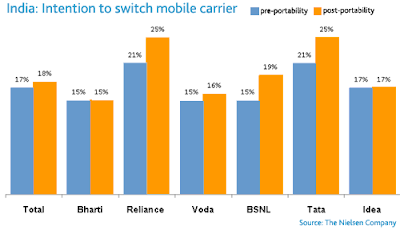
The important fact however is that 17% of all Indian mobile customers were planning to change their operator pre-MNP itself. (Refer to the comparison chart) That means an increased interest of just 1%. The 17% people would very well throw away their current SIM and get another one of their preference, like they have been doing before MNP rollout. This is another factor. How many people love their number so much that they would prefer to go through the lengthy porting procedure instead of getting a new SIM and letting others know of the new number by SMS or something? As far as publicity is concerned, MNP has been in news for quite some time due to the lengthy and often postponed rollout procedure; so many people already should have heard of it. Idea has already started airing ads on MNP asking people to "switch to Idea", making it to look like a service they are offering. BSNL went one step ahead by offering stuff like free talktime to people porting in. Good strategy, I'd say. But speaking of the MNP scenario in the USA, Analysys states that "most top tier carriers hopped on the MNP advertising bandwagon when the concept was first introduced in 2003 but hopped back off almost as quickly. Since advertising the MNP option didn't make a major impact on consumers' decisions to port their numbers most carriers decided they would rather spend their budget advertising new phones and price plans." That is exactly what is going to happen in India too.

Obviously the cons outweigh the pros. I have been working closely with an operator for MNP implementation and testing, and I have to say that the time, money and manpower spent on MNP is not worth it. TRAI should have done enough feasibility studies to understand the massive effort the whole rollout would require in a unique case like India with about 300 operators spread in 23 circles and the possible impact of the service. I'd like to wind this up with a quote by Colonel (retd), S. N. Aggarwal, a Delhibased consumer activist. "MNP is going to be a mess. There is absolutely no coordination between TRAI and the operators."

Tuesday, July 13, 2010

Inception: Hype and its Impact on Box-Office

Ever since Inception was announced, the film circles were abuzz with news of anything from release date to probable plots. The collaboration of the director of The Dark Knight and one of the biggest stars of Hollywood was of course destined to be hyped. The release date nears and the hype is building up exponentially propelled by the largely favourable reviews and media promotions. The Dark Knight too witnessed huge hype in the run-down to its release. We know that was due to the promos focusing on The Joker played by the talented Heath Ledger, whose unexpected demise had grabbed headlines. While it is certain that The Dark Knight would still have become a blockbuster had Ledger survived that drug overdose, it is doubtful if it would have bagged the record $158 million in the opening weekend. Before the release of Iron Man 2, a Yahoo report wondered if it would dethrone The Dark Knight from the opening weekend gross record, considering the huge hype. It ended up trailing a whole $30 million.

What make me somewhat nervous about the insane hype around Inception are its uncommon genre and the fact that it's not belonging to a pre-established premise like The Dark Knight or Iron Man 2 for that matter. The global box-office phenomenon Avatar pretty much negates the latter point. I had quoted the same reason and “optimistically" projected Avatar to gross up to $1 billion globally, hoping the 3D and favourable reviews will somehow push the film up to that. That one apparently will end up grossing almost thrice as much. But Avatar is an exception, and a huge one at that. As of 11 July 2010, Avatar's total gross is $2.73 billion, out of which only $750 million is collected domestically. In other words, a whopping 72% of the gross was collected from foreign territories. Even though the foreign collection share is very high, it’s not uncommon for blockbusters to collect more from foreign territories. In fact all Top 20 global blockbusters have collected more from foreign screens; all but one. The Dark Knight, with 53% domestic share is the one which is out of the league. Obviously the deeper we go into a comparative analysis between The Dark Knight, Avatar and Inception, the more it gets complex. To put it straight, Avatar with a huge hype and a non-established premise went on to collect in normal blockbuster pattern with a fatter foreign share. The Dark Knight with more hype and established premise ended up collecting more domestically.

The hype of Inception might not be as huge as The Dark Knight, but it is comparable to that of Avatar. The problem here, as I mentioned above is that the premise is not only unfamiliar to the audience, it seems to be a bit convoluted too. The first Inception review to get published stated that we, the audience are so used to being treated like idiots; which means that Inception is a film which makes you think. You won’t see many "brainy" movies with non-established premises in the top of the blockbusters table. I remember one report jokingly describing Inception as a weirdo/sci-fi/heist/thriller film. IMDb describes it as a drama/mystery/sci-fi/thriller. The amalgamated genre outcome may very well end up being unappealing on incomprehensible for the general public. That’s why I'm wary of the hype. The hype would help the film to gross around $70 million domestically in the opening weekend, but if the general public goes to the film expecting an action/thriller film as indicated by the TV spots, things may get bad in the second week. It would have been much better if they gave stress to the drama part as well. And I hope the film don’t end up looking so geeky to the common audience. I will of course be very happy to find myself proven too pessimistic in this matter after two weeks. Let's hope the audience will reward a director who trusts their intelligence.

Inception opens on 16 July 2010.

More info on Inception from Wikipedia.

Visit the Official Website.

Play the official Inception mind crime game.

Thursday, June 10, 2010

The Grand Theft Auto (GTA) Series Trivia


I had compiled this as a mail to friends in December 2006, and just came across it again now. I thought I'd share it. I have not edited it with new sales figures and GTA IV is not even considered until the very end. Despite that, it chronicles the importance and impact of the GTA series in video

games sphere. The below facts will surely enthuse hardcore gamers...not sure about others, but they might find the 14 th point rather interesting!!!


1.

GTA franchise is the 6th highest selling game series of all time, after Mario (193 million), Pokémon (155 million),Final Fantasy (68 million),The Sims (54 million) and Madden NFL (51 million). The Grand Theft Auto series has sold 50 million games.

2.

Debuting Years:Mario (1981), Pokémon (1995),Final Fantasy (1987),The Sims (1989),Madden NFL (1984),Grand Theft Auto (1998)

No. of games in the series:Mario (130), Pokémon (493),Final Fantasy (12),The Sims (27),Madden NFL (20),Grand Theft Auto (6 with 4 'add-on's)

Considering the above facts, GTA series has the highest sales per game of all time. And the vast majority of the sales are for GTA III, Vice City and San Andreas.

3.

Individually, the top-seeling games of all times are shown below:

i. Super Mario Bros. 3 (18 million)

ii. Super Mario Land (14 million)

iii. Grand Theft Auto: Vice City (13 million)

iv. Grand Theft Auto: San Andreas (12 million)

v. Grand Theft Auto III (11 million)

vi.Super Mario 64 (11 million)

vii.Gran Turismo 3: A-Spec (11 million)

Note that the 3,4 & 5 positions are for the GTA games.

4.

The San Andreas sales figure of 12 million has been recorded within 6 months of its release, making it the one to get the highest initial sales.

5.

In the Sony PlayStation2 platform, the 3 highest selling games are San Andreas, Vice City & GTA III respectively!

6.

The games in the GTA family are:

Grand Theft Auto

a. Grand Theft Auto: London, 1969

b. Grand Theft Auto: London, 1961

Grand Theft Auto 2

Grand Theft Auto III

a. Grand Theft Auto: Liberty City Stories

Grand Theft Auto: Vice City

a. Grand Theft Auto: Vice City Stories

Grand Theft Auto: San Andreas

Grand Theft Auto Advance

7.

The hero of GTA III had no name. Infact he never uttered a single word throughout the game. But at the ending of San Andreas, it is revealed that the GTA III hero’s first name is Claude! Interestingly, the hero of GTA 2 has the name Claude Speed!

8.

The difference that made the GTA series click is the freedom that it offers gamers to choose their mission (or even not to choose!). GTA III combined the sand-box style and open-world style of gaming. The GTA gameplay was replicated by atleast 20 game series that released after the success of it.

9.

The fictinal cities in the GTA series are actually inspired from some American Cities:

Liberty City: New York

Vice City: Miami

San Andras: Yeah, you guessed it right…San Francisco.

10.

GTA San Andreos stars Carl CJ Johnson, an African-American... making it the first game of its sort to star a black man. Also, like the previous two GTA games, San Andreas's voice actors includes notable celebrities, including Charlie Murphy, Samuel L. Jackson, James Woods, Peter Fonda, Frank Vincent, the late Chris Penn, rappers Ice T, Chuck D and The Game and musicians Axl Rose and Shaun Ryder.

11.

The hero of the GTA series couldn't swim. When he falls to water he just sinks and GAME OVER! But that problem was solved in San Andreos, where he was gifted with the ability to swim.

12.

The GTA series was under fire since the launch of GTA III because of its violent nature. GTA III and Vice City has pending lawsuits in the US courts. The major criticism was on the focus of illegal activities in the game compared to the good-man heros of other usual games. The main character can commit a wide variety of crimes and violent acts while dealing with only temporary consequences, including the killing of policemen and military personnel. Opponents believe that players will try to emulate this behavior.

On October 20, 2003, the families of Aaron Hamel and Kimberly Bede, two young people shot by teens William and Josh Buckner (who in statements to investigators claimed their actions were inspired by GTA III) filed a US$246 million lawsuit against publishers Rockstar Games and Take-Two Interactive Software, retailer Wal-Mart, and PlayStation 2 manufacturer Sony Computer Entertainment America. The lawsuit was dismissed later.

13.

Another criticism was on racial abuses in some parts of the games. Dialogoues like"These Haitians! We take 'em out!" and missions to kill immigrants from Haiti and Cuba landed the Vice City in fire.

14.

A factor that the gamers of GTA notice is the excess of nudity and sex. In GTA III the hero could take prostitutes to his car and after some intended sex, increase his health upto 125 points, which stops at 100 otherwise! The girl will take money from you but you can get it back by killing her! A bit brutal, isn’t it? Because of some problem with the Australian game censorship board, this feature was disabled in the Australian version! The biggest of all fuck-ups (as per the GTA language) was the San Andreas ‘Hot Cofee’ controversy. At one point of the game, one girl invites Carl CJ Johnson, the hero for a ‘hot coffee’ to her house. The game actually had some intended sex between the two with swivelled camera motion from ouside the house and some ‘ooh..aah’s. But after installing a unofficial add-on patch, the player actually can go into the house and have ….you know what! It actually acted like a mini-game with crude graphics. The gamer really has controls and the ‘mission’ is to keep the ‘excitement level’ of the girl to the max! It is debated that the ‘hot coffee code’ was actually there in the game package and the patch just opens it up!

The ABC (Australian Broadcasting Corp ) news about the controversy.


Below are the links to the GTA trailers:

GTA III:

GTA Vice City:

GTA San Andreas:


NB: The next game in the series, GTA IV released in April 2008. True to the heritage of the series, the title also was a smash-hit. As of May 2010, it is the Guinness World Records holder of "Highest grossing video game in 24 hours" and "Highest Revenue Generated by an Entertainment Product in 24 Hours" titles.


More info on the series:

Wikipedia page

Rockstar Games

Tuesday, May 18, 2010

Taxi Driver (1976) & There Will Be Blood (2007):

A Comparative Study

Daniel Plainview (Daniel Day-Lewis): I.. drink.. your.. milkshake!

Travis Bickle (Robert De Niro): You talkin to me? You talkin to me?

I got to watch these two fine pieces of cinema last weekend. And I felt both have a few major aspects in common, other than them being products of fine celluloid craftsmanship. Firstly, both of them are deep character studies in general and the narration of the plot takes a back seat. Not that the premise is irrelevant, they surely help in shaping up the character. The dark streets of New York in the 1970s and oil rigs of California in the early 1900s have shades of gloom and filth splattered over. There are moments of cheer, but they are few. The films get darker as the story progresses. Both films are blessed with superlative performances by the lead stars. Travis Bickle (Robert De Niro) and Daniel Plainview (Daniel Day-Lewis) are not exactly full of admiration for the people around them. While Bickle wishes somebody could flush the city "down the fuckin toilet", Plainview declares he sees the “worst in people”.

There is however something inherently different about the two guys. Bickle's hatred is built on his experiences, which might even have contributed to his psychological issues. He even wants to correct the world around him. Plainview on the other hand, built up his hatred so as to succeed, for not letting anyone else to win. That makes him downright evil; much, much more evil than Bickle. Add to that his short-temper that and in Plainview we have one of the most dislikeable lead characters ever. Plainview is as unpredictable as Bickle, but is not as stupid or bizarre as him. He won't take a girl to a sex education movie on a date or attempt to assassinate a senator wearing a very distinguishable Mohawk hairdo.

Another interesting aspect would be the people they care for. Bickle develops kind of a paternal affection to a teenage prostitute he sees on street and is hell bent on liberating her. He eventually succeeds in it too. Plainview on the other hand has his adopted son, who thinks Plainview is his real father. He is perhaps the only person Plainview loved. Yeah, past tense. As soon as his son's intentions to start his own company are clear, he starts to hate him too calling him a "bastard for a basket".

The murders they commit are also curiously reflective of their persona. Bickle shoots his way to the prostitute who he wants to save, utilising every move he had been rehearsing in front of mirrors. Cool heroic stuff, even though the whole exercise almost gets him killed. But that he is just back after attempting to assassinate a senator, who seems quite a decent man doesn’t go well with that heroic image. He is “a walking contradiction”. Plainview’s murders on the other hand were not necessary at all. He killed people who were entirely surrendered to him. In situations where most others would have been mellowed, he is enraged like hell and mercy is not something he is familiar of. This man is pure evil.

I think it’s now clear that I am more intrigued by Plainview than Bickle. I also think Daniel Day-Lewis belted out a more superior performance than Robert De Niro. But then this is me. Comprehensive character driven dramas like these can have a thousand interpretations and can garner a million conflicting opinions.

Taxi Driver
Directed by Martin Scorsese
Written by Paul Schrader
Distributed by Columbia Pictures
Release date: February 8, 1976

There Will Be Blood
Directed by Paul Thomas Anderson
Written by Paul Thomas Anderson
Distributed by Paramount Vantage
Release date: December 26, 2007

Sunday, January 31, 2010

2001: A Space Odyssey (1968)
"I'm sorry, Dave. I'm afraid I can't do that."
I still have not stopped scratching my head. I dozed off three times while watching the film. I watched it yesterday night and all this time I can't stop thinking about it. Damn, I even had dreams on it! Kubrick has made a glorious example of self-indulgent film making. The starting itself with prolonged idle shots of a prehistoric desert, he makes it amply clear that he is gonna take his own bloody time to tell what he got to say. The story is told in 4 phases and in each but one, a mysterious big black tablet appears supposedly due to some extra-terrestrial activity. In the first chapter, it is told how the tablet might have influenced human's thinking capabilities. The chapter named 'the dawn of man' is the story of ape men starting to use tools. Though the entire story is revolving around this tablet, nothing much is revealed on it other than that it has a huge magnetic field and that it sent a wave of radiation towards Jupiter. The third chapter on the expedition to Jupiter is the most interesting one, when an artificial intelligence computer on board the mission ship encounters a clash of interest with the astronauts. This film was made in 1968 and the kind of imagination that went into the making of this film is amusing. There are elaborate sequences on activities of and in space ships, with support from extensive sets and camera tricks which has to be revolutionary at the film's time. I think many later space films have taken cues from 2001 on various aspects of space life as well as filming techniques. The 'characterization' of the AI computer nicknamed HAL is the highlight of this film for me. The use of classic music gives an all different feel to scenes featuring space ships. There is a prolonged sequence of some photo active phenomenon that an astronaut goes through when he nears the surface of Jupiter. Only God and Kubrick knows what happened at the climax, and I'm not so sure about the former. Certainly, this film is not everyone's cup of tea, but if you are into serious cinema and want to experience what a director in command do to you with ambiguous imagery, they go witness the Odyssey.

2001: A Space Odyssey
Directed by Stanley Kubrick
Produced by Stanley Kubrick
Written by Stanley Kubrick and Arthur C. Clarke
Distributed by Metro-Goldwyn-Mayer
Release date: April 6, 1968

Wednesday, December 23, 2009

AVATAR: Box Office Analysis

The long awaited 3D Sci-Fi epic film AVATAR, directed by James Cameron has finally hit the screens around the globe on 18 December 2009. In the opening weekend, the film managed to gross $77 million from approx 7000 screens in North America and an estimated $164.5 million from the rest of the world, excluding big markets Japan and China where the film will open on 23 December and 2 January, respectively.
While the opening is solid, it is far from spectacular. Before release, Fox had estimated the opening weekend gross to be around $50 million - $60 million range, which I thought was too pessimistic. A day after release, Fox again repeated their under-estimation when they reported that AVATAR was poised to collect $73 million. Fox might have been cautious because of the notoriety of the North American market which responds coldly to non-established premises with no star power despite the scale of production. Other blockbuster openings of the year like The Twilight Saga: New Moon ($143 million), Transformers: Revenge of the Fallen ($109 million) and X-men Origins: Wolverine ($85 million) were sequels belonging to highly popular franchises with devoted fan following. Even the films with the all-time highest grossing opening weekends like The Dark Knight ($158 million) and Spider-man 3 ($151 million) were in that league. AVATAR, as we know has a non-established premise created by writer-director James Cameron. No wonder Fox was on back foot. Incidentally, AVATAR's figures are the best ever for a non-sequel film.
Fox's conservative projection may also be a trick so as to bestow the tag "exceeding studio expectations" to AVATAR. They played a similar game with the film's budget. The New York Times set the rumour bells ringing loud in November when they reported that AVATAR has "a price tag approaching $500 million". The Wrap in December quoted a Fox spokesperson as saying that the budget for AVATAR "is $237 million, with $150 million for promotion, end of story." Even to this day, there is no clarity on the actual budget of the film which is being promoted in territories like India as the biggest film ever.
Coming back to Fox's estimate, the industry as a whole however expected a sum much more than Fox's projection. Eventually AVATAR did exceed studio expectations, but fell short of industry expectations. Other than the usual December collection pattern where blockbuster openings rarely happen, the film suffered due to the cold wave that swept the American east coast regions and parts of Europe. Fox reported a collection drop of 18% in New York City, 57% in Philadelphia and as much as 75% in Washington, DC on saturday.
AVATAR, with its excellent word-of-mouth and favourable reviews will withstand any cold wave and will be collecting in the range $800 million - $1 billion worldwide. Considering that the studio nets about 50% of domestic and 40% of overseas collection, the prospects of the film in DVD market and the product/merchandise tie-ins, the sum which will leave Fox and their partners Dune Entertainment and Ingenious Media, who reportedly bore 60% of the film's cost laughing all the way to the bank. They deserve that for having faith in the King of the World.

Thursday, December 10, 2009


Book Review: Orachante Oramakkurippukal (Memories of a father) by Eechara Warrier

The book is a memoir by Professor T. V. Eechara Warrier on the events following the arrest and custodial murder of his son Rajan, an egineering student at the Regional Engineering College, Calicut, Kerala during The Emergency. It is a rather small book but rich in chilling recollections of the darkest days of Indian history since partition. The book is also a critical study of our political and legal establishments. We would expect a lot of criticism towards Karunakaran, but he is more or less spared citing "only that can be expected from him." It is Achutha Menon, considered Kerala's best CM till date by many, who comes under heavy criticism for his cold attitude towards Prof.Warrier. Prof.Warrier explains it came as a rude shock to him because Menon had taken refuge under him when he was in exile.

The author's lack of experience in writing is evident as he keeps on repeating certain points. Nevertheless its a powerful and poignant recollection of a father's search for his son and his fight for justice.
The English translation of the book is published by Asian Human Rights Commission and the e-book is available free of charge:

Sunday, August 02, 2009

Ritu: An inspired Viral Campaigning
Ritu is the 6th film directed by acclaimed Malayalam film director Shyamaprasad. The film written by Joshua Newton features fresh faces in major roles. The film's music is by Rahulraj, and the album has 5 songs. I think the appropriate spelling should have been Hrithu, but who gives a damn?
The film has a fresh feeling around it and it might become a landmark film in Malayalam cinema. That, we will have to wait and see. As of now, what makes this film special is its viral marketing campaign. I have seen some films making half-hearted attempt at it, but this kind of a full-fledged viral campaigning is unprecedented in Malayalam film industry.
The film has pages on:
Plus the film has a minimal but interesting website (http://ritumovie.com/), which has fantastic layout and concept. The beautifully crafted trailers and posters of the film have a unique touch to thm; they carry light, dark and daring attittudes at the same time. I have a good feeling about this. If they have put in the same kinda care and dedication into the film itself, we might get a pathbreaking film, after a long time.

Ritu opens on August 7th, 2009.

Friday, July 31, 2009

Microsoft Bing's 'sex'ual discrimination

Have u ever searched the term 'sex' on bing.com, Microsoft's new search engine? Most certainly not. If u ever wanted to do that, u would have done that thru Google. I heard about this funny aspect of bing search and I searched 'sex' on bing and we know that the term 'sex' in many usages is not that sinister. I have two screenshots put together in the pic.
The top one is the first result you will get if you are searching from India. Bing declares that the results may be explicit and demands change of search term for results! If u need results, just change the location to.. say US. Tada! Bing springs to action and claims that it has returned 1.7 billion results. Google returns 0.7 billion results for 'sex'! Just have look at the related searches tag. Girls? 2009? Sigh! And none of the results on the first page on bing had links to porn sites, while Google had a couple of them. Its clear that even if Microsoft and Yahoo join hands aginst Google, unless they induce some common sense to the engine, nothing gonna happen.

Sunday, July 12, 2009

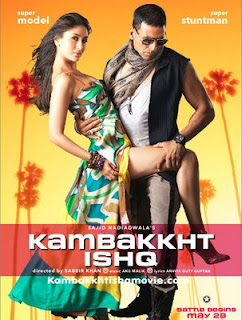
Reviews: Kambakkht Ishq and Transformers: Revenge of the Fallen


It would be fun comparing the big summer flicks of Bollywood
and Hollywood, which have garnered similar reaction from critics and the box-office. I mean the critics were thrashing the films black and blue while the films were raking in really big dough. T2 (I apologise to all terminator fans, but the second installment of Transformers has a painfully long name to type) has grossed over $600m globally in 2 weeks, while KI has netted around Rs.36 crores in the first week, both very good figures by respective industry standards.

KI is supposed to be the bollywood-meets-hollywood
film, but that backdrop pales out in comparison the central theme of the battle of sexes, which itself is ridiculously lame. So what does it have? I does have Sly Stallone, who got a feel of bollywood than the reverse. The cameos by Brendon Routh and Holly Valance lacks punch, and Denice Richards just acted in what perhaps is the most gawky and sidelined roles in her career. And Kareena? She is convincing sometimes, but mostly is unimpressive.
Akki? Well,the man and his comic timing are the only only things worth in the film, considering that most of the jokes are not funny at all. And yes, the film has such number of kisses that it can put Emran Hashmi to shame. So is it worth a watch? Yes, if you have no value to your time and money.

T2 picks up where the first film has left, but has a lot of back-story to tell. The best thing about the film is that it is as big as we expect it to be. CGI is used in almost every scene of the film and it, despite being some what 140 minutes long (a bit too long by hollywood standards) is having a thorough script. You have to keep your logic out of the hall, though. This is a feat for your senses if you like kick-ass films. Guess what, I found this action film to be funnier than KI, which is supposed to be a comedy. They have dragged in a family angle to the film, which was sometimes ok, but mostly not. LaBeouf and Fox have done what they are supposed to do pretty well, but the real stars of this film is the men who created the CGI. If you are looking for a perfect action filled weekend film, look no further.

Sunday, February 01, 2009

Is Slumdog Millionaire anti-Indian?
This is one interesting controversy. The originator of it, Amitabh Bachchan has taken it a U-turn, and has already called Slumdog Millionaire a "wonderful film". But more and more people are joining what "The Independent" calls a smear campaign (http://in.news.yahoo.com/43/20090131/908/ten-smear-campaign-hits-oscar-favourite.html). The latest one to join is Priyadarshan. He has called the film a "cheap trashy mediocre version of erstwhile Bollywood hits." (http://in.news.yahoo.com/43/20090201/914/ten-slumdog-millionaire-is-mediocre-tras.html) Well, in all fairness, we know that Priyan has made many "cheap trashy mediocre versions of erstwhile Hollywood hits," but let it stay there. There is one point in which I would tend to agree to him: "The angry director wonders why there isn't a single shot in 'Slumdog...' that shows the more aesthetic side of Mumbai?" So here we are. Just how anti-Indian is Slumdog Millionaire?

I just compiled a list of negative portrayals of India/Indians in the film. Some of them true, some exaggerated:
1. Police brutality, including a never-heard-before shock therapy.
2. The slums, especially the toilets. No comments.
3. A boy getting himself bathed in s**t to get an autograph of Bachchan.
4. The riots. (A boy dressed as Rama just stands there, amidst all hullaballoo! And I have no idea how Jamal understood that its Rama.)
5. The mafia which creates child beggers; the children made blind to enhance the impact.
6. The kid theieves in trains.
7. Fraud tour guides.
8. People steals the bulk of the spare parts of a car in which Jamal had brought his foreign tourists. The Indian driver brutally assaults Jamal for this, the angel foreigners intervenes and pays Jamal some American bucks as compensation!
9. The red street.
10. The underworld.
11. In the call centre, the agents replace themselves with a chai-wala, and he in turn gives wrong directions to the caller. In another scene, almost all the agents leave their desks to whatch KBC.
12. In broad daylight, gangsters chases and abducts a girl in the VT railway station!
13. A game show host who hates the guy in hot seat because err.. he is a chai wala? Also the host gives the wrong answer to him during a break pretending to be helping!

On the positive side, there are:
1. High rise buildings (in the middle of a sea of huts)
2. The Taj Mahal
3. The call centres
4. You can see that I am clearly short of points here.

So we are back to the original question. Just how anti-Indian is Slumdog Millionaire?

Sunday, November 30, 2008

26/11: How India is losing its fight against terror
There were 10 of them. Or so the reports say. But the terrorist captured during action thinks he came with 14 others. Right there begins the tragedy. We don’t really know how many of those bloodthirsty bastards were ravaging through the heart of India. Even most of those terrorists who were gunned down could have escaped if they really wanted. Posing as a guest of the hotel wouldn’t have been that difficult, considering the fact that the police were not exactly verifying the people coming out were really guests. But they didn’t want to escape. Though the headlines screamed of ‘hostage drama’, I think the terrorists were NOT interested in taking hostages. They just killed anybody who came across them. Had they been interested in creating a hostage crisis, the outcome might have been very different. Like what happened in Kandahar in 1999, we would have ended up releasing some other imprisoned ultra and he may go on to establish yet another terror outfit. India is known for its diversity; it even holds for terrorism. We have ULFA terrorists, naxalites and saffron terror outfits in addition to a multitude of Islamic terror outfits.

Now, on the 26th of November 2008, a group of terrorists reportedly came from the Pakistani city of Karachi via sea route to some seaside town in Gujarat. They abducted a boat from there, and proceeded towards Mumbai. They killed the 2 men in the boat just before reaching Mumbai. Then they boarded a dinghy, and landed in the Mumbai soil. What followed is the darkest episode in the history of India. India was defeated in a war, had its prime leaders executed more once, saw scandals in deals of coffins for dead soldiers, witnessed its citizens engaging in inhumane gory riots. But nevereverever this happened previously: a group of foreigners in Indian soil held the whole country under siege. We had NO information, NO preventive measures, NO security measures and NO crisis management mechanism. To add to this we had NO proper guns, NO trained personnel, NO ‘useful’ bullet-proof vests and helmets readily available. We had to wait till the National Security Guards arrival from New Delhi. The number of personnel of the Marine Commandos was very less and the army was unequipped to counter a situation like this. Where is our gigantic defence budget ranging to tens of thousands of crores of Rupees utilised?

We can’t complain about the crisis taking so long to end. The situation was delicate, and the commandos couldn’t take too much risk because even the number of terrorists and more importantly the number of people trapped in the besieged buildings were UNKNOWN. We have seen hostage crises in countries with ‘more elite’ forces including Israel dragging through days. We Indians were not used to the prolonged standoffs; probably the reason behind the media starting to wonder whether even the most elite forces of the country were INADEQUATE. To add to this the terrorists holed up in Mumbai’s landmark buildings were highly motivated, skilled, intelligent and informed. They knew the blueprint of the buildings, especially the Taj Mahal hotel by heart. My friend from Mumbai on the second day of the siege called them ‘tiger cubs’ and jokingly suggested that some of them should be roped in to train our forces. As time passed it ceased to be a joke. By every passing second they were winning. They did maximum damage to lives, buildings and to the confidence of and on India. When the situation proceeded, they seemed to be in full control. I painfully realised that we had lost this time, yet again.

I saw Shobhaa De, a well known columnist saying she wants to see ‘heads roll’. I thought, well, she has been seeing that literally in the past few days. And as I write, I am seeing heads starting to roll, starting with the home minister Shivraj Patil. Patil was heavily criticized every time India came under attack from terrorists, but this time his party decided enough is enough. Everybody was angry against politicians. It’s always easy to blame. Changing heads of state is not a solution. We don’t want new governments doing the same old things. We want to strengthen our internal security. Next time some motherfucker decides to have a go in India, we need a response team readily available. We can’t expect the Intelligence to bring in a fully compiled list of future terrorist strikes. Even the world’s biggest and most sophisticated spy agency, the CIA failed to collect proper info about the 9/11. Intelligence might give leads, and we should not neglect them. Even now, there are reports that the IB had warned the government regarding terrorism through sea route. Even if the IB fails to get info, we should be ready for the worst, all time. We need SWAT like elite forces in all state police departments. And we need them ready.

Soon enough the gore will be washed away, there will be merry again. But we should not forget. In 60 hours, 195 people were massacred, including 42 security personnel. This year over 2000 people were killed in terrorist violence all over the country. We shall never forget. We shall not lose another time.

Tuesday, November 25, 2008

DOSTANA: Has homosexuality become the in-thing in India?

The first attempt from Indian cinema at a sympathetic outlook towards gays. The Mira Nair film Fire was perhaps the first Indian film to deal with homosexuality, though the lesbian couple featured were married to men and probably were bisexual. Homosexuals being forced to suppress their nature and get married 'straight' is not a rarity in India. Anyways I can't say much about Fire as I am yet to watch it. Karan Johar brought in the cocept of gays to popular cinema with the Shah Rukh - Saif 'couple' in Kal Ho Na Ho. Going the tongue-in-cheek way and being slapstick at times, the scenes were meant to be funny only and nothing else. Most of the depictions of gays in the subsequent films like Masti were mere rework of the original Kal Ho Na Ho idea. Films like Life in a Metro and Honeymoon Travels Pvt. Ltd. did feature real gays, but the films had them as 'closeted': having straight life and having to 'cheat' to satisfy their you-know-what. Those two being what is called as multiplex films, Dostana is the first popular Indian cinema to orient predominantly on homosexuality, though the major cast only poses as gays to get an apartment for rent! This Karan Johan (The KHNH Connection!) produced film didn't do too much escapism which most other films flirted with. Even without the title characters played by Abhishek Bachchan and John Abraham being gays, the film throws a flash of light over the aspect of homosexuality in a very sympathetic way. This includes the female lead star's sentimental take on gay love to one of the 'gay' person's mom and depiction of a conservative mother who comes in terms with the fact that his son is a 'gay'! Kudos to the makers of the film for taking up such a risky subject and delivering an out and out entertainer with a message. And hats off to Abhishek and John for taking up the roles and even going upto the extreme of acting in an intended gay kiss scene! Homosexuality is certainly the in-thing in Indian cinema, but it might no be so about the Indian soceity.
The success of the film might not immediately raise demand for gay rights in the country, but it is a good start. I myself belong to the soceity which considers homosexualty as a taboo and like many others me too feel awkward while watching a gay kiss scene in films. The estimated number of gays in India is around 2.5 million and proper number of lesbians is unavaliable. Homosexuality is a crime in India with punishment upto life sentence. I am not sure if anybody was punished for being gays, though. Most of homosexuals in India live a 'closeted' life fearing the soceity's wrath. Compared to homosexuals, transsexuals known popularly as hijras in India are more apparent, but generally they too live a life away from the main course of the soceity. Its high time we Indians understand that homosexulaity and transsexuality are natural phenomena or say the act of the naughty God.
WTF is Hindu Terrorosm?

This is a not-so-publicised photo of an alleged Bajrang Dal training camp. Now after the Nanded and Malegaon blasts we are hearing the term "Hindu Terror" more and more. Extremist Hindu bodies were part of India even before its birth, but they were not associated with the word terrorism until recently. Now, after the Malegaon blasts targetting muslim areas, the Mumbai ATS has rounded up on various Hindu oufits. One on the Nanded blast accused reportedly said during narco test "We will be treated like hijras if we don't take action. Counter-attacks are the only way of avenging terror attacks". That reminds me of 'a wednesday'. That also reminds me of America's so-called War on Terror.

"An eye for an eye will make the whole world blind" - Mahatma Gandhi.

Amen!

Sunday, September 07, 2008

iPhone in India
7 months after its worldwide release, the most celebrated gizmo of recent times made its official debut in India on 22 August 2008. The hype it created in India was nowhere near what we saw in the US. Reasons are pretty obvious. Indians are not quite used to the idea of network-locked phones. iPhone is brought to India by Airtel and Vodafone, which are India's biggest mobile network operators. Despite that, Indians are more comfortable with buying a phone from a phone outlet than a network operator's outlet. If at all they decide to try that out they will soon find themselves with a much lighter wallet. The iPhone3G is priced at Rs.31000 (starting from) i.e. around $750, and the non-3G version is not released in India. It’s pretty odd that in a country with no 3G network, people are forced to buy a 3G phone. It should be noted that the same iPhone3G prices are startung from $199 in the US. That would perhaps make iPhone the only thing on earth that costs cheaper in the US compared to the price in India. As if these all were not enough, the iPhone comes with a 'technical glitch' from an Indian's perspective. It seems that Apple Inc has a little bit more respect for intellectual property than the Indians. The transfer of files from an iPhone to other non-i phones is not possible. Or at least that’s what my friend with an iPhone says.
Having said all this, the iPhone remains a first-class gizmo for the upper class and middle class kids who think they are the upper class. In a country with ever-increasing number of high earning professionals who make lots of calls and like music, the iPhone do have a space.